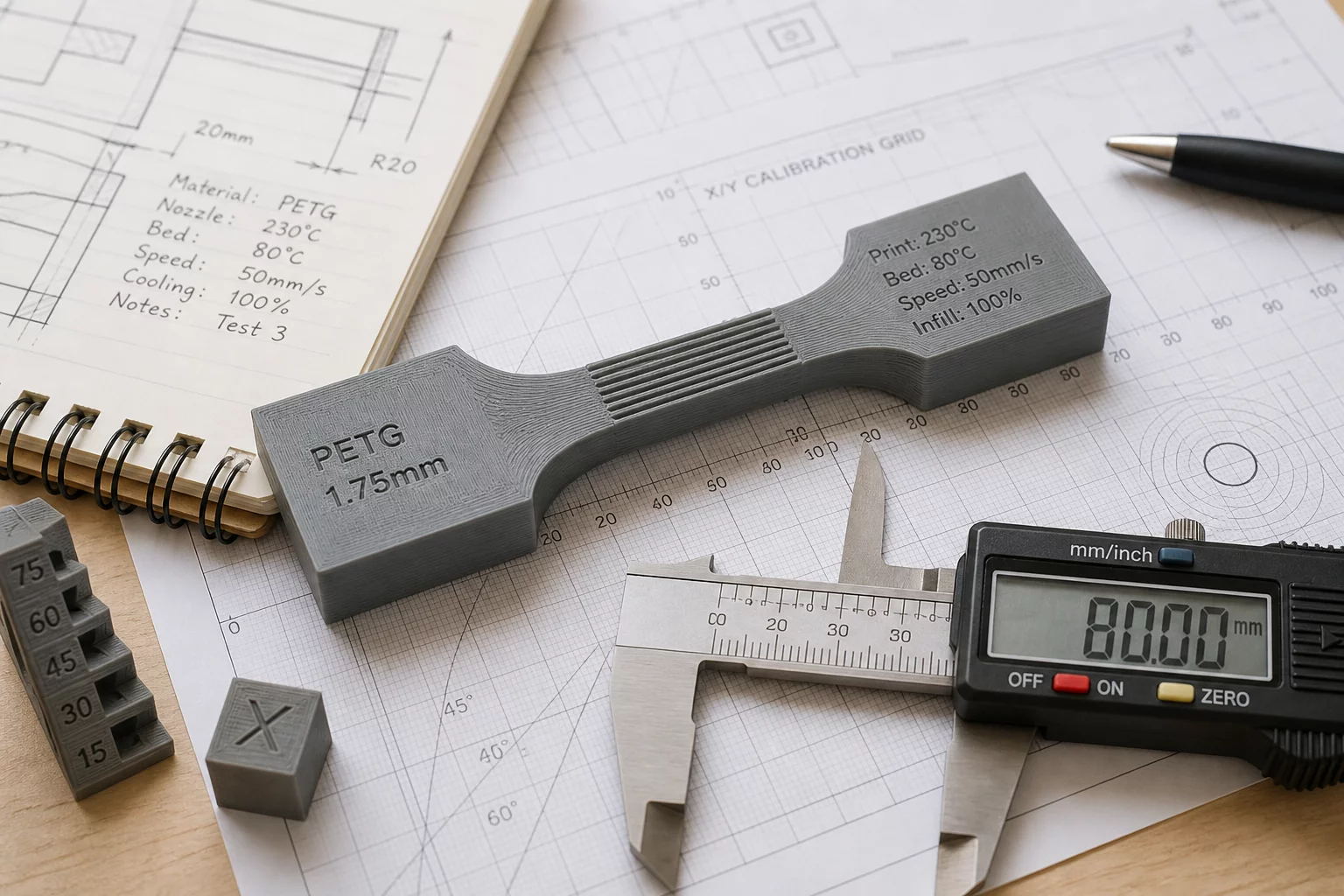
Foundational Prototyping Principle
All workbooks, parameters, formulas, and calibration tests presented across this platform adhere strictly to the rule: One print. One question. One observable result. Users must verify every specimen independently in a safe, controlled workshop environment.
1. Educational & Prototyping Purpose
The materials, guides, test matrix worksheets, and parameter recommendations provided on PartTrial Workbook are published strictly for educational, informational, and experimental engineering trial purposes.
This website does not provide certified industrial manufacturing specifications, structural engineering warranties, or aerospace/medical component validations. You are solely responsible for checking whether your physical test specimen meets your specific mechanical, thermal, and regulatory requirements.
Recommended Practical Step
Always start with small-volume calibration geometries before allocating full build volumes or production-grade filament batches.
2. Hardware, Thermal & Electrical Safety
Additive manufacturing equipment operates under elevated temperatures (hotends reaching 300°C+, heated beds reaching 110°C+) and continuous electrical loads. Test procedures documented on this site require attentive monitoring.
- Never leave experimental trial prints unattended during high-temperature or non-standard speed iterations.
- Maintain functioning thermal runaway protection enabled inside your machine firmware at all times.
- Ensure adequate workspace ventilation, air filtration, and fire safety equipment compliant with local workshop regulations.
3. Material Variances & Chemical Behavior
Filament behavior varies considerably across different polymer blends, pigment loadings, ambient moisture levels, storage durations, and spool manufacturers. Baseline values provided in our Materials and Guides are baseline starting references rather than absolute guarantees.
Extrusion temperature, retraction distance, cooling fan thresholds, and bed adhesion settings must be calibrated per individual material spool to achieve predictable mechanical results.
4. Dimensional Tolerances & Mechanical Fits
Dimensional measurements and clearance guidelines listed in our Trial Workbooks reflect specific ambient test conditions and calibrated stepper driver steps-per-millimeter ratios.
Minor thermal contraction, nozzle wear, belt tension discrepancies, or lead screw backlash will influence real-world part fit. Digital caliper verification remains an indispensable step for every physical iteration.
5. Third-Party Slicers & Software Compatibility
Our technical workflows and examples often reference slicing software and toolchains such as PrusaSlicer (PrusaSlicer Trial Guide) or open-source g-code utilities. PartTrial Workbook operates independently and maintains no direct corporate affiliation with third-party software vendors unless expressly specified.
Users must verify generated G-code layer previews before transferring instructions to physical machines.
6. Limitation of Liability
To the fullest extent permitted under applicable law, PartTrial Workbook and its authors disclaim all warranties, express or implied, regarding accuracy, completeness, or suitability of the published prototyping workflows for any particular use case.
In no event shall the project organizers be held responsible for equipment damage, material wastage, assembly malfunctions, personal injury, or consequential losses arising directly or indirectly from the implementation of published worksheets, formulas, or test protocols.
7. Questions & Method Clarifications
If you identify an ambiguity, calculation error, or outdated slicing parameter within any of our public engineering worksheets, please share your documented observations with our team.