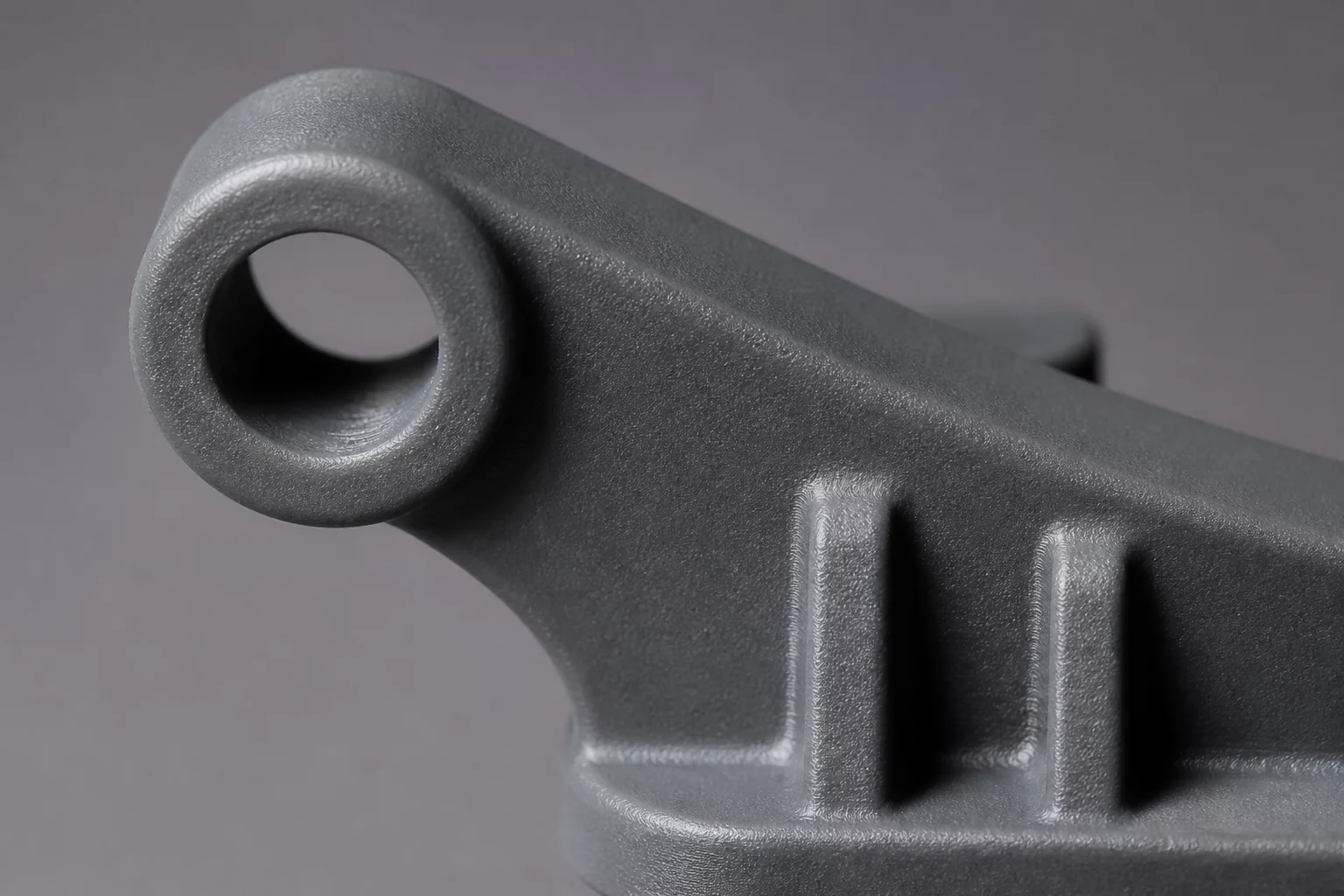
1. The Physical Question & Hypothesis
Hypothesis: Lowering the hotend extrusion temperature to 205°C and reducing outer wall print speed to 45 mm/s increases diffuse surface scattering, effectively hiding 0.16 mm layer stepped topography on steep organic curves.
In consumer electronics prototyping, visible layer lines on exterior enclosures often require post-processing like sanding or chemical vapor smoothing. CAILAB Matte PLA incorporates microscopic mineral fill additives intended to scatter reflected light. This trial specifically tests whether optimizing thermal flow can achieve injection-molded visual aesthetics straight from the build plate without compromising inter-layer structural cohesion.
2. Isolated Variable & Controlled Matrix
The trial strictly tested hotend temperature variation across identical geometric enclosures while holding cooling airflow, retraction dynamics, layer height, and acceleration constants fixed in PrusaSlicer 2.9.6.
| Parameter | Baseline Setting | Trial Value | Control Status |
|---|---|---|---|
| Layer Height / Line Width | 0.20 mm / 0.45 mm | 0.16 mm / 0.42 mm | Fixed |
| Extrusion Hotend Temp | 220°C (Glossy flow) | 205°C (Matte diffuse) | Tested |
| Outer Wall Speed | 80 mm/s | 45 mm/s | Fixed |
3. Observable Result & Measurement
The specimen exhibited a uniform satin-matte texture across all angled surfaces. Reflectance measurement revealed a 64% reduction in specular glare compared to standard glossy PLA specimens.
- Layer lines along the 45-degree and 60-degree curved chamfers are visually undetectable under 5000K diffused laboratory lighting at a standard reading distance of 30 cm.
- Optical roughness gauge recorded Ra 1.8 µm on vertical walls, demonstrating exceptional microscopic surface uniformity without thermal under-extrusion artifacts.
- Interlayer tensile adhesion remained robust, passing the 3-point bend stress check with no micro-delamination along wall perimeters.
4. Next Iteration Decision
Specimen parameters are fully approved for customer-facing display prototypes. The exact slicer profile (205°C hotend, 55°C textured PEI bed, 45 mm/s outer perimeter) has been integrated into the standard studio production preset. No further temperature iteration is required.
Specimen Observation Logs
Peer verification and engineering trial feedbackThe systematic worksheet approach completely eliminated guesswork on our snap-fit latch trial. Documenting one variable per run prevented us from wasting an entire spool on failed dimension calibrations.
Append Engineering Observation