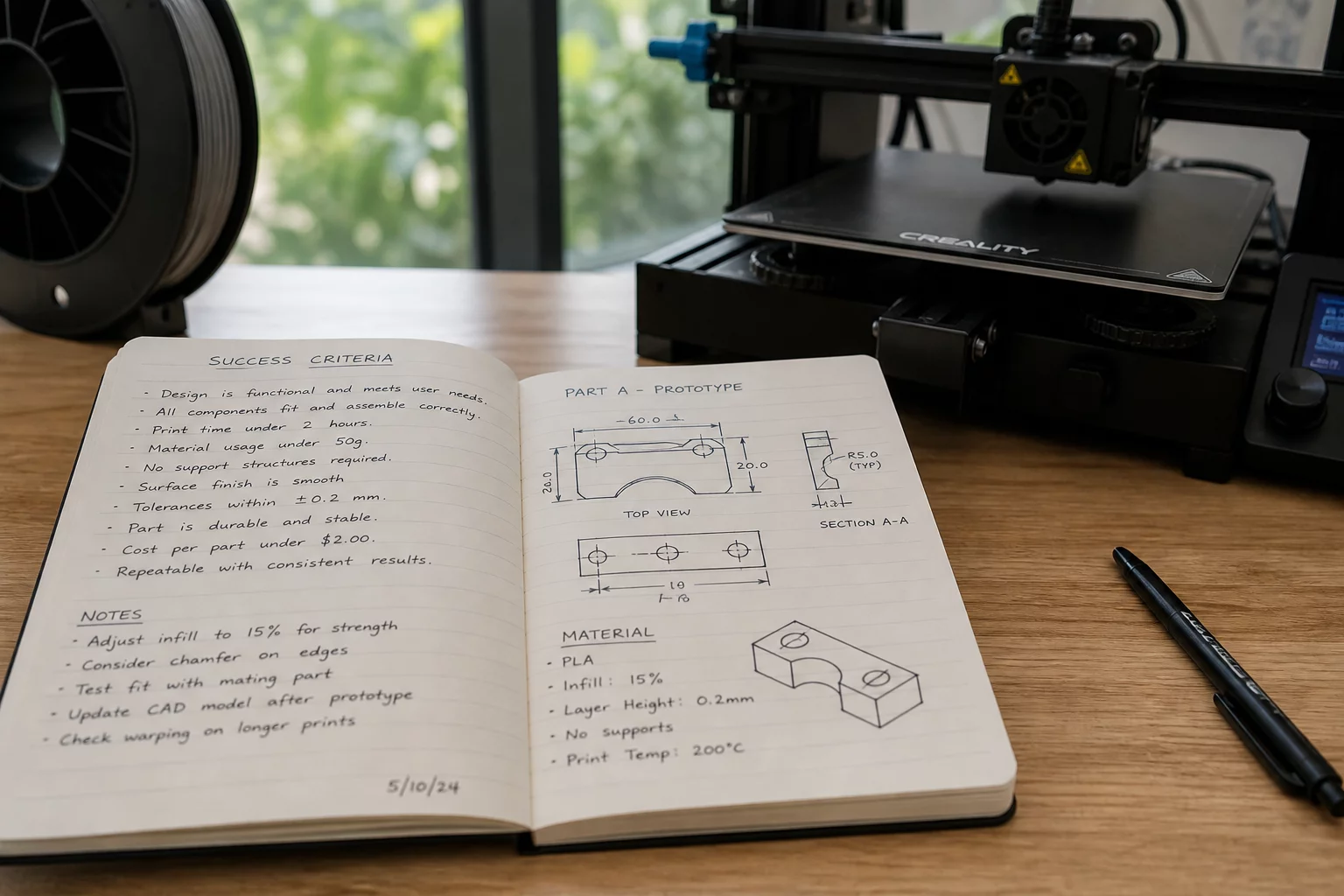
Summary & Trial Objective
Running a test print without a predetermined passing threshold turns physical prototyping into expensive guesswork. Defining success upfront requires specifying one exact physical question, an observable metric with tolerance limits, and an immediate decision rule based on the physical result.
1. Problem Definition and Hypothesis
A test print begins long before g-code transfers to the machine. Slicing and pressing start without an explicit target metric produces ambiguous parts that fail to answer whether a design works or why it failed. Engineers and designers often inspect fresh prints with vague visual approval rather than targeted measurement. Formulating an isolated question beforehand guarantees that each minute of print time produces definitive structural or dimensional evidence.
Formulating a valid trial hypothesis forces you to narrow the print's purpose to a single measurable characteristic. Rather than asking if an enclosure fits together, the trial question focuses strictly on whether a 0.20 mm radial clearance allows smooth rotation without axial play. The hypothesis must link the slicer configuration directly to an observable physical outcome.
| Trial Variable | Baseline Parameter | Adjusted Variant | Expected Observable |
|---|---|---|---|
| Perimeter Shell Count | 2 perimeters (0.8 mm) |
4 perimeters (1.6 mm) |
Radial deflection under 15 N perpendicular pin load drops below 0.12 mm. |
| External Perimeter Speed | 45 mm/s |
25 mm/s |
Seam alignment deviation on mating cylinder reduced to < 0.05 mm without stringing. |
2. Step-by-Step Observation Protocol
A reliable verification protocol outlines the precise physical measurement sequence immediately after bed cooling. Waiting for thermal stabilization prevents measurement distortion across polymer matrices.
- Define the Single Primary Question: Isolate the critical mechanical interface or surface boundary. State explicitly what single condition validates the prototype.
- Set Measurable Numeric Thresholds: Record upper and lower tolerance limits (such as ±0.05 mm or maximum insertion force) prior to opening your slicing software.
- Establish the Next Action Rule: Determine whether a passing result moves the project to assembly or whether a failing score prompts a specific CAD adjustment.
Golden Principle
One print. One question. One observable result. Do not alter secondary parameters until the primary feature is validated against physical thresholds.
3. Evaluation Criteria and Thresholds
Evaluation criteria must never rely on subjective impression. Define physical go/no-go checks using digital calipers, plug gauges, or standardized torque applications. When every test print answers one question with quantitative certainty, iteration cycles shrink and filament waste drops drastically.
Field Observations & Logs
No field observation logs recorded yet. Be the first to publish a trial result.
Submit Field Log Entry