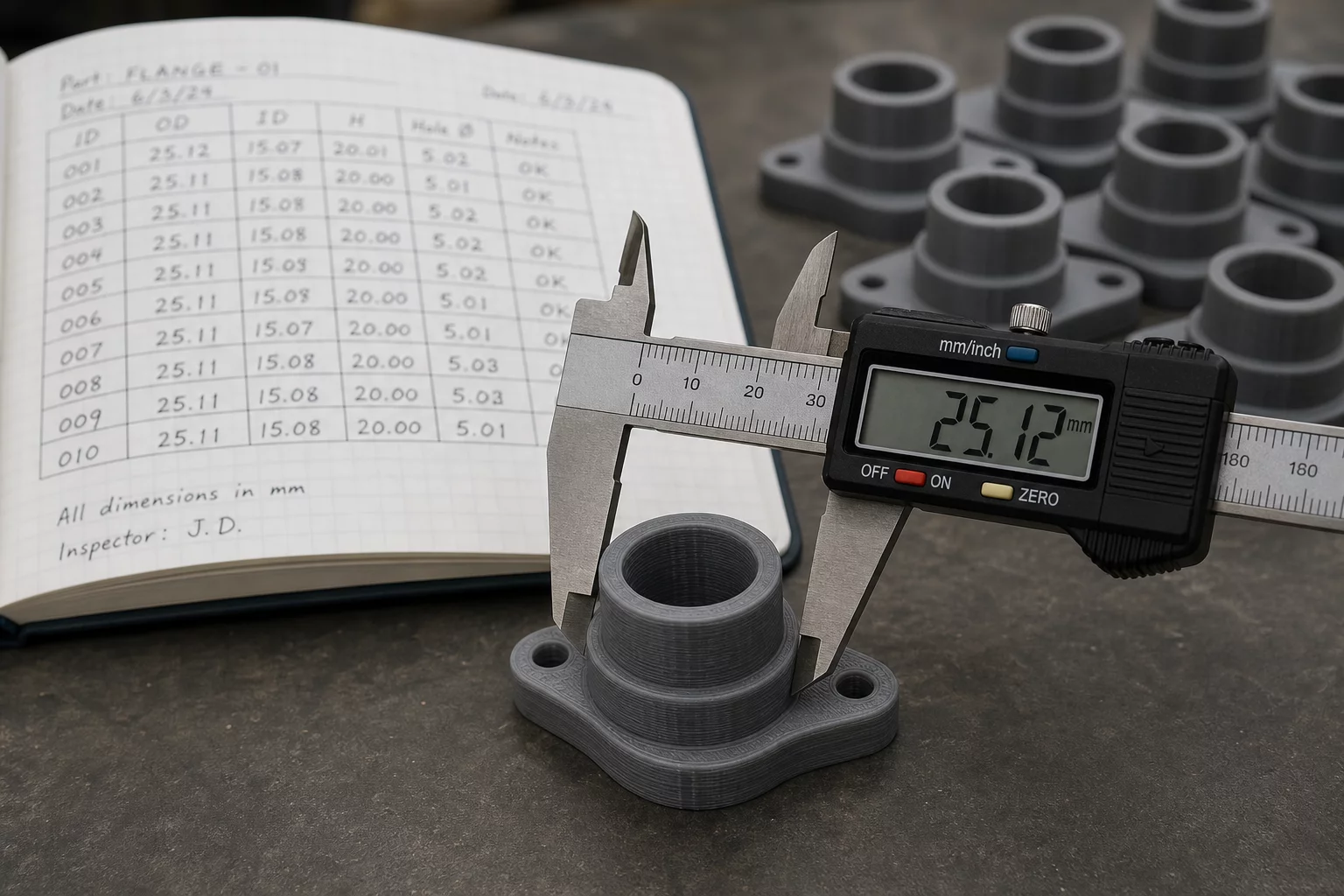
Summary & Trial Objective
Single-print evaluations only verify isolated functionality. When a design moves toward small-batch production or repeatable assemblies, testing identical parts across print cycles reveals bed leveling discrepancies, thermal fluctuations, and mechanical backlash that single trials hide.
1. Problem Definition and Hypothesis
Prototyping teams often assume that if a single snap clip or gear prints cleanly, ten consecutive copies will perform with the exact same friction and fit. In practice, thermal accumulation in the heatblock, ambient chamber temperature shifts, and minor lead screw variance introduce subtle dimensional drift. The Repeated-Part Observation Log is designed to capture these micro-variations systematically across multiple identical runs.
Instead of measuring every single dimension randomly, focus on one critical datum feature across all specimens. If you are testing a press-fit boss for an M3 brass threaded insert, measure the internal diameter of five consecutive parts printed in the same bed location, then five parts distributed across different build plate quadrants.
| Trial Variable | Baseline Parameter | Adjusted Variant | Expected Observable |
|---|---|---|---|
| Bed Location Distribution | Center (X:125, Y:105) |
Four Outer Quadrants |
Internal diameter variance across build plate perimeter |
| Print Order Sequencing | Sequential (1 by 1) |
Simultaneous (All at once) |
Stringing, retraction seam bulge, and cycle cooling uniformity |
2. Step-by-Step Observation Protocol
Execute the repeated-part observation protocol by strictly isolating physical measurement conditions and recording datums immediately after cooling.
- Thermal Stabilization: Allow parts to cool completely to 22°C room temperature on the build plate before removal to avoid mechanical deformation during detachment.
- Tri-Point Caliper Logging: Measure the designated critical feature three times per specimen at 120-degree rotations, noting minimum, maximum, and average values in your ledger.
- Seam and Toolpath Audit: Inspect whether the slicer placed seams identically on every specimen or randomized start points, which can induce inconsistent dimensional swelling.
Golden Principle
One print. One question. One observable result. Do not alter secondary parameters until the primary feature is validated against physical thresholds.
3. Evaluation Criteria and Thresholds
Evaluate your batch using standard deviation rather than single-point success. If outer diameters fluctuate beyond ±0.06 mm across 5 parts, adjust outer perimeter acceleration in PrusaSlicer 2.9.6 down to 800 mm/s² before modifying extrusion multiplier. Once measurements stabilize within acceptable limits, seal the log and advance the part to functional assembly testing.
Field Observations & Logs
No observation logs submitted yet. Be the first to record a specimen trial.
Submit Field Log Entry